



From Idea To Reusable Rule Systems
Most traders start with a checklist, then miss steps when markets move fast. With Coinrule, Crypto automation frameworks become reusable rule blocks you can test, clone and deploy across venues without code.
Design rule-based automation fast with Coinrule. Build reusable entry, exit and risk frameworks, then run them on Binance, Kraken, OKX and Hyperliquid.

410k+
users building rules
2M+
strategies executed
20+
Exchanges Supported
Most traders start with a checklist, then miss steps when markets move fast. With Coinrule, Crypto automation frameworks become reusable rule blocks you can test, clone and deploy across venues without code.
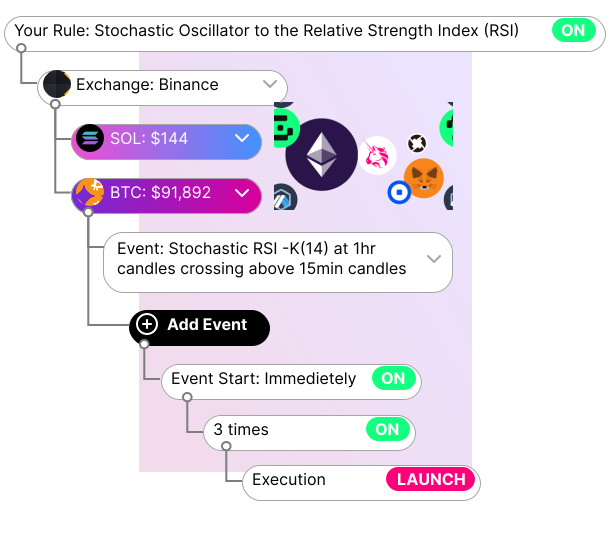
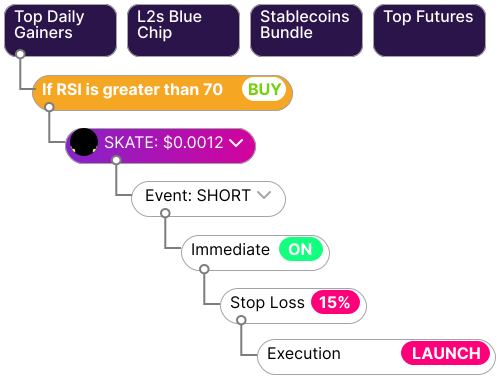
Link accounts via API keys and run the same logic on Binance, OKX, Kraken or Coinbase. The engine standardizes order types, position sizing and alerts so your process stays consistent when you switch pairs.
Every strategy can include hard stops, cooldown timers and allocation caps. Set a daily risk limit like 2 percent per rule and pause after three stop-outs. Logs and alerts help you audit what happened.
Framework Blocks
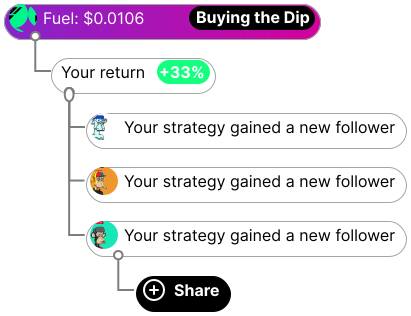
Build frameworks from simple components: price moves, indicators and schedules. Example: if BTC drops 5 percent in 4 hours and RSI(1H) is below 30, buy 1 percent, then set a 3 percent stop and 6 percent take profit.
Multi-Venue Execution
Run spot rules on Coinbase while hedging perps on Hyperliquid from one dashboard. Keep strategies separated by account, or coordinate them with shared risk limits and global pause controls.

Buy the Dips
Buys after a 4 percent pullback from a 24H high with RSI below 40. Adds once more if price drops another 3 percent. Exits on a 6 percent rebound or when RSI exceeds 60.

Grid Trading
Places a grid of buys and sells inside a defined range, such as plus or minus 5 percent. Uses equal order sizes and cancels the grid if price breaks out. Best for sideways markets.
DCA Accumulator
Splits a monthly budget into scheduled buys, like $500 into four $125 weekly entries. Adds an extra buy when price dips 3 percent in a day. Reduces buys if volatility spikes above a set threshold.

Stop Loss and Trailing Take Profit
Enters on a breakout signal, then sets a fixed 2.5 percent stop loss. Trails take profit by 1.5 percent once price is up 4 percent. Locks gains while avoiding premature exits.

Supertrend Momentum
Buys when Supertrend flips bullish on 4H candles and volume rises above its 20-period average. Sells when Supertrend turns bearish or price closes below the trend line. Designed for trend phases.
Buy the Dips
Buys after a 4 percent pullback from a 24H high with RSI below 40. Adds once more if price drops another 3 percent. Exits on a 6 percent rebound or when RSI exceeds 60.
Grid Trading
Places a grid of buys and sells inside a defined range, such as plus or minus 5 percent. Uses equal order sizes and cancels the grid if price breaks out. Best for sideways markets.
DCA Accumulator
Splits a monthly budget into scheduled buys, like $500 into four $125 weekly entries. Adds an extra buy when price dips 3 percent in a day. Reduces buys if volatility spikes above a set threshold.
Stop Loss and Trailing Take Profit
Enters on a breakout signal, then sets a fixed 2.5 percent stop loss. Trails take profit by 1.5 percent once price is up 4 percent. Locks gains while avoiding premature exits.
Supertrend Momentum
Buys when Supertrend flips bullish on 4H candles and volume rises above its 20-period average. Sells when Supertrend turns bearish or price closes below the trend line. Designed for trend phases.
Bollinger Band Mean Reversion
Buys when price closes below the lower band and RSI is under 35 on 1H. Sells at the middle band or after a 2 percent bounce. Exits if no rebound occurs within 12 hours.
Portfolio Rebalance
Rebalances back to target weights, like 50 percent BTC and 50 percent ETH, every week. Rebalances sooner if any asset deviates by more than 7 percent. Helps keep risk aligned.
Funding Rate Hedge
When funding turns strongly positive, opens a small hedge on perps while keeping spot exposure. Closes the hedge when funding normalizes or after a set time window. Aims to reduce carry risk.
Volatility Breakout
Buys when price breaks above the last 20-candle high and ATR expands by 20 percent. Sets a stop at 1x ATR below entry and takes partial profit at 2x ATR. Avoids low-liquidity hours.
Mean Reversion with Z-Score
Enters when the Z-score of price vs a moving average drops below -2. Exits when Z-score returns to 0 or after 24 hours. Adds a max loss rule to cut trades that keep trending against you.
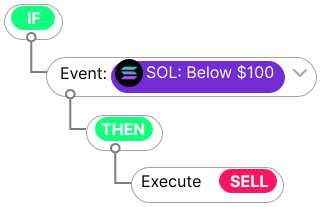
Instead of building one-off bots, treat each rule as a module you can reuse. Coinrule lets you copy a proven entry filter, then swap only the asset list or timeframe. Cap total exposure at 30 percent and any single coin at 12 percent.
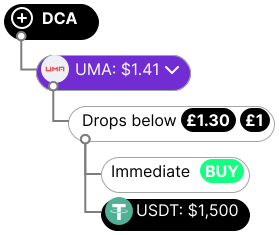
Traders iterate faster with a structured process. Start with a simple rule, then add one constraint at a time: a trend filter, a time stop, then a trailing exit. For example, enter when MA50 crosses above MA200 on 4H, but only if volume is 15 percent above its 20-period average. Review logs, adjust thresholds and relaunch.
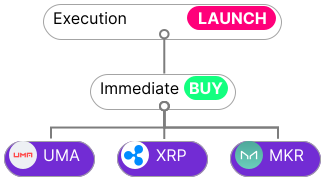
Your funds stay on your exchange accounts while Coinrule sends orders through API permissions. Use read and trade keys, disable withdrawals and rotate keys on a schedule. This keeps control with you while enabling systematic execution.



When you want decentralized execution, use smart-account infrastructure for self-custody. Session keys can grant limited permissions, and routing can seek best liquidity across pools. It is a clean way to automate without sharing private keys.
Launch BotFAQ
 Lars H.
 Priya K.
 James W.
 Mei L.
 Diego R.
 Amara N.
Start by saving your best entry filters as templates you can reuse. Keep one version for trend markets and another for range conditions. Over time you will trade fewer ideas, but execute them better.

Set portfolio limits like max 25 percent in alts, max 3 open positions and a daily loss cap of 2 percent. Add a rule that pauses all strategies for 6 hours after the cap hits. These constraints reduce overtrading.


Combine one trigger with one confirmation instead of stacking ten indicators. For instance, use a breakout above the 20-day high, then confirm with ADX above 20. If confirmation fails, skip the trade.

Use limit orders for planned entries and market orders only for emergency exits. Add slippage buffers on fast pairs and avoid thin liquidity hours. Small execution choices often beat complex signal tweaks.

Review the trade log weekly and tag parameter changes. When performance shifts, trace it back to a specific edit rather than guessing. That feedback loop is the real edge of systematic trading.
Create one framework, run it on a small allocation and expand only after you trust behavior across market regimes. Coinrule supports a gradual path from experiment to dependable automation.
Get Access