



From Idea To Orders Without Guesswork
Most traders think in outcomes, not order types. With Intent based trading on Coinrule, you define what you want to happen and the platform translates it into consistent actions across venues.
Turn goals into rule-based execution with intent-based trading on Coinrule. Automate entries, exits and risk controls across exchanges in minutes.

410k+
users building automations
1M+
strategies executed
20+
Exchanges Supported
Most traders think in outcomes, not order types. With Intent based trading on Coinrule, you define what you want to happen and the platform translates it into consistent actions across venues.
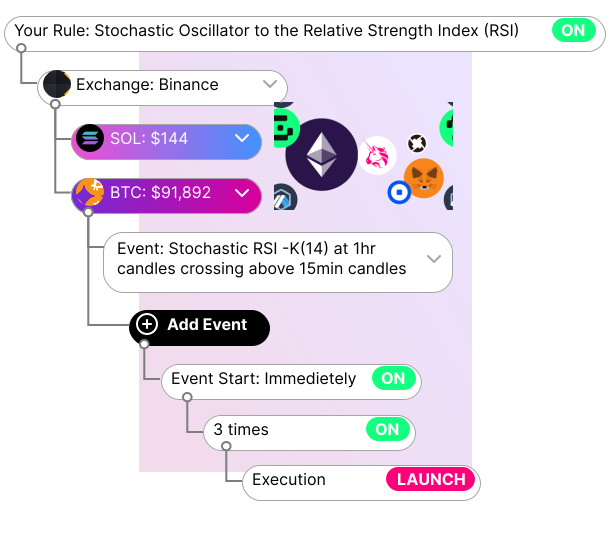
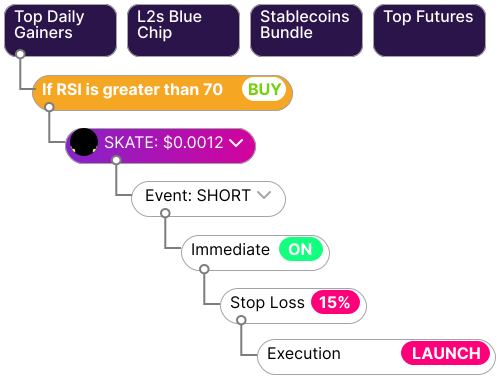
Instead of staring at charts all day, you set triggers that express your thesis. For example, buy 2% of balance if price drops 5% in 4 hours and RSI(1H) is below 30. Add a second condition like MA100 above price to avoid fighting strong downtrends. These rules run the same way on Binance, Coinbase, Kraken, OKX or Bybit. You can backtest logic with historical candles and then go live with the same settings.
Traders often lose edge when they improvise entries or move stops mid-trade. Coinrule keeps your plan intact with rule logs, alerts and repeatable execution. You can pause, clone or schedule strategies when market regimes change. Use time filters to avoid low-liquidity hours or to trade only the London-New York overlap. The system is built for consistency, not constant tinkering.
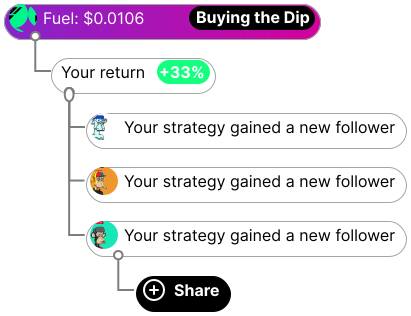
Intent To Risk Controls
Risk controls are part of the intent, not an afterthought. Set a hard stop at 2.5%, then switch to a trailing stop of 1.2% once profit exceeds 4%. Add position sizing like max 8% per coin and max 25% total exposure to alts. You can also require confirmation, such as volume above the 20-period average before entering. These guardrails help keep one bad candle from becoming a portfolio event.
Multi-Venue Intent Routing
Coinrule connects non-custodially via API keys on CEXs and supports perps venues like Hyperliquid. You keep custody while the engine coordinates signals, orders and notifications from one dashboard.

Buy the Dips
Buys after a 4% drop from the 24H high and RSI(4H) below 35. Adds one more buy if price falls another 3%. Exits on a 6% rebound or RSI above 60.
Grid Trading
Places a grid of buy and sell orders inside a defined range, like +/- 5% around current price. Re-centers the grid if price breaks out by 3%. Uses a max order count to cap risk.
Volatility Breakout
Enters when price closes above the prior 20-candle high and ATR expands by 15%. Sets a stop at 1.8x ATR. Takes profit with a trailing stop once up 3%.

Stop Loss and Trailing Take Profit
Opens on a signal you choose, then applies a fixed 2% stop loss. When profit reaches 3%, switches to a 1% trailing take profit. Designed to protect downside while letting winners run.

MA Crossover with Volume Filter
Buys when MA20 crosses above MA50 and volume is 20% above its 20-period average. Sells when MA20 crosses back below MA50. Avoids low-volume fakeouts.
Buy the Dips
Buys after a 4% drop from the 24H high and RSI(4H) below 35. Adds one more buy if price falls another 3%. Exits on a 6% rebound or RSI above 60.
Grid Trading
Places a grid of buy and sell orders inside a defined range, like +/- 5% around current price. Re-centers the grid if price breaks out by 3%. Uses a max order count to cap risk.
Volatility Breakout
Enters when price closes above the prior 20-candle high and ATR expands by 15%. Sets a stop at 1.8x ATR. Takes profit with a trailing stop once up 3%.
Stop Loss and Trailing Take Profit
Opens on a signal you choose, then applies a fixed 2% stop loss. When profit reaches 3%, switches to a 1% trailing take profit. Designed to protect downside while letting winners run.
MA Crossover with Volume Filter
Buys when MA20 crosses above MA50 and volume is 20% above its 20-period average. Sells when MA20 crosses back below MA50. Avoids low-volume fakeouts.

RSI Divergence Hunter
Looks for bullish divergence: price makes a lower low while RSI(1H) makes a higher low. Enters on confirmation close above the prior candle high. Exits at RSI above 65 or a 2% stop.
VWAP Reversion Scalper
Buys when price is 1.5% below intraday VWAP and RSI(15M) is under 35. Sells when price returns to VWAP. Includes a time stop to exit after 90 minutes.
Liquidity Sweep Breakout
Enters after a sweep below support followed by a close back above the level. Confirms with a higher high on the next candle. Uses a tight stop under the sweep low and trails profits.
Dynamic Grid with ATR Spacing
Builds a grid where spacing adapts to ATR, widening during high volatility and tightening in calm markets. Limits total deployed capital to a set percent. Cancels and rebuilds if ATR doubles.
Funding Rate Hedge
When funding turns strongly positive, reduces long exposure and adds a small hedge position. Removes the hedge when funding normalizes. Designed for perps risk control during crowded longs.
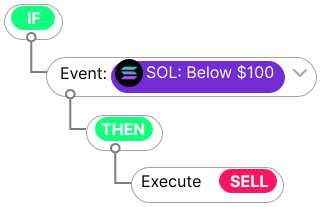
Unlike rigid bots, Coinrule lets you express intent as modules you can combine. Start with an entry block, add a risk block, then add an exit block. Example: enter on a Donchian 20 breakout, risk 1% per trade, and exit on a close below MA50. You can run the same logic on multiple pairs with different sizing. This makes it easy to standardize how you trade without forcing one template on every market.
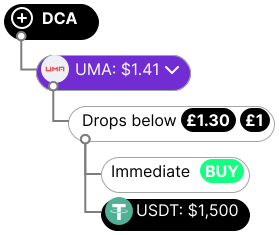
When you manage more than one asset, intent is often about allocation, not a single entry. Use intent-based trading to rebalance weekly, for example: if BTC dominance rises 3% in 7 days, shift 5% from alts into BTC. Or if ETH underperforms BTC by 4% over 14 days, rotate 3% into ETH. Add a volatility filter so rebalances pause when ATR(1D) spikes above a threshold. These rules turn portfolio decisions into repeatable flows.
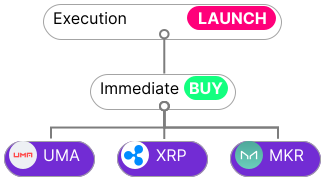
For centralized exchanges, connect via API and keep funds on the venue. Coinrule supports major markets like Kraken, KuCoin, Bitget and Bybit, so you can automate without changing your stack. If you trade perps, you can run systematic hedges and trend rules with clear liquidation-aware sizing. On-chain execution is available on Base, Arbitrum and Binance Smart Chain for users who prefer smart-account workflows. One interface, multiple venues, consistent logic.



Every action is logged so you can review why a trade happened. Alerts tell you when a condition triggers, when an order fills and when a safety rule blocks execution. Set cooldowns like one entry per 6 hours to prevent overtrading. Use global stops to pause all strategies during news shocks. Control matters as much as speed.
Launch BotFAQ
 Lars H.
 Priya K.
 Emma T.
 Diego R.
 Kenji M.
 Amara N.
Start by writing the outcome in plain language, then map it to signals. If your intent is to buy weakness, choose RSI or a percent drop trigger. If your intent is to follow trend, use MA crossovers, Supertrend or Donchian breaks. This approach prevents indicator overload. It also makes your strategy easier to debug when performance changes.

Rules can include time windows and confirmation candles to avoid chasing spikes. For example, require a close above resistance, then wait for a retest within 0.8% before entering. Add a max spread condition on illiquid pairs. These small constraints often matter more than adding another indicator. Execution becomes calmer and more repeatable.


Once a strategy works, clone it and change only a few parameters. Keep the same structure, but adjust thresholds like RSI 30 vs 35, or stops like 2% vs 3% based on volatility. Use separate allocations per bot to avoid hidden correlation. This is how systematic traders scale without losing control. Coinrule makes that workflow fast.

Your funds do not sit on Coinrule. On exchanges, the platform sends orders through your API permissions, and you can revoke access anytime. On-chain, smart accounts and session keys can limit what a strategy is allowed to do. This separation of execution and custody is a core safety feature. It keeps automation practical for serious users.

If you want to go deeper, compare approaches in /automated-trading and explore risk setups in /risk-management. You can also review indicator-driven workflows in /trading-strategies. Each guide focuses on turning a clear plan into repeatable execution. Use them to refine your next iteration.
Pick one intent, define three conditions, and let the system run it for a week. Review the log, tighten risk and iterate. Consistency is the real edge you can control.
Start Free