



Automate A Steady Stacking Plan
Instead of guessing entries, a Silver accumulation strategy can be expressed as simple rules in Coinrule. Set recurring buys, add extra tranches on pullbacks, and track performance from one dashboard.
Build a rules-based silver stacking plan with Coinrule. Automate DCA, dip entries, exits and risk limits across connected exchanges in minutes.

410k+
users building automated rules
1M+
strategies executed
20+
Exchanges Supported
Instead of guessing entries, a Silver accumulation strategy can be expressed as simple rules in Coinrule. Set recurring buys, add extra tranches on pullbacks, and track performance from one dashboard.
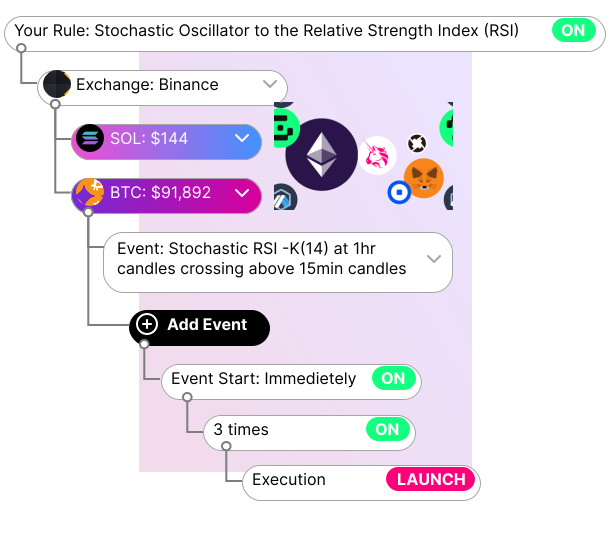
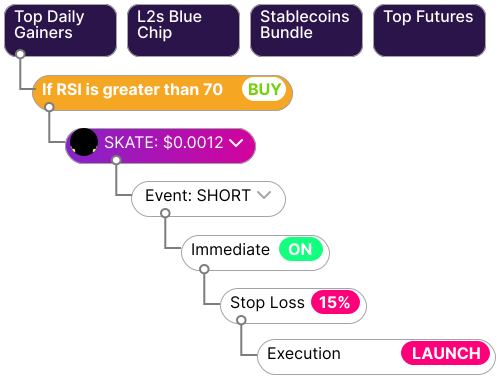
Traders often accumulate through a mix of time-based buys and conditional orders. Define triggers like 4% dips in 24 hours, RSI below 35 on 4H candles, or a break back above a support zone, then execute automatically. Cap exposure per day, week, or signal so the plan stays consistent.
Every bot needs guardrails. Use stop loss, trailing take profit, and drawdown pauses so a long-term plan does not become a runaway position. Review logs and alerts to see what fired, then iterate without emotion.
Rule Templates For Accumulation
Pick a template, then adjust sizing, timeframes and filters to match your risk tolerance. For example, buy 1% of balance every Monday, add 0.5% if price drops 4% in 24 hours, and pause if weekly drawdown exceeds 8%. These constraints create a process you can follow.
Non-Custodial By Design
Coinrule runs automation through exchange API permissions, so you keep custody and can revoke access anytime. Start with read-only keys for monitoring, then enable trading only when you are ready. This keeps execution systematic while your security model stays simple.

DCA Accumulator
Buys a fixed amount on a weekly schedule. Adds an extra buy if price dips 3% within 12 hours. Pauses after a 7% weekly drawdown.

Buy the Dips
Places laddered buys when price drops 2%, 4% and 6% from a recent high. Exits a portion after a 5% rebound. Uses a time stop if no bounce in 5 days.

Grid Trading
Runs a grid inside a defined range with equal spacing. Buys at lower grid levels and sells at upper levels. Best for sideways markets with clear boundaries.
Bollinger Band Mean Reversion
Buys when price closes below the lower band on 4H candles. Sells when price returns to the middle band. Adds a 2.5% stop loss to limit tail risk.
RSI Oversold Rebound
Buys when RSI falls below 30 on 1H or 4H charts. Takes profit when RSI crosses above 55. Filters entries by requiring volume above its 20-period average.
DCA Accumulator
Buys a fixed amount on a weekly schedule. Adds an extra buy if price dips 3% within 12 hours. Pauses after a 7% weekly drawdown.
Buy the Dips
Places laddered buys when price drops 2%, 4% and 6% from a recent high. Exits a portion after a 5% rebound. Uses a time stop if no bounce in 5 days.
Grid Trading
Runs a grid inside a defined range with equal spacing. Buys at lower grid levels and sells at upper levels. Best for sideways markets with clear boundaries.
Bollinger Band Mean Reversion
Buys when price closes below the lower band on 4H candles. Sells when price returns to the middle band. Adds a 2.5% stop loss to limit tail risk.
RSI Oversold Rebound
Buys when RSI falls below 30 on 1H or 4H charts. Takes profit when RSI crosses above 55. Filters entries by requiring volume above its 20-period average.
Support and Resistance Bounce
Buys near a defined support zone after a rejection wick. Sells at the next resistance level or on a 3% move. Cancels entries if support breaks by 1.5%.
Stop Loss and Trailing Take Profit
Enters on your chosen signal, then sets a fixed stop loss. Trails take profit once price is up 4% to lock gains. Exits fully if the trail is hit.
TWAP Execution Accumulator
Splits a larger buy into smaller slices over 2-6 hours. Reduces slippage during volatile sessions. Cancels remaining slices if price spikes 2% above the start.

Volatility Breakout
Buys when price breaks above a recent high with ATR expanding. Adds only if the breakout holds for 3 candles. Exits on a close back inside the prior range.

Portfolio Rebalance
Targets a fixed allocation and rebalances on a schedule. Sells small portions after rallies and buys after dips. Uses bands like +/- 3% to avoid over-trading.
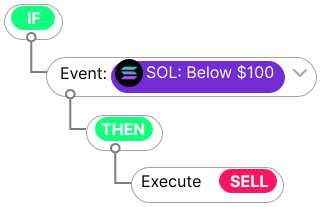
Traders usually fail on sizing, not signals. Set position size as a percent of available balance, or cap total exposure across all bots. A practical rule is 0.5% per entry, max 5% total, and a weekly spend limit that resets every Monday.
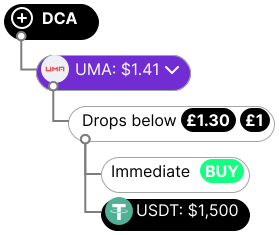
Rather than relying on one method, blend scheduled buys with opportunistic adds. You might run a base DCA weekly, then add a smaller tranche when RSI drops below 35 on 4H candles. This keeps accumulation steady while still taking advantage of selloffs.
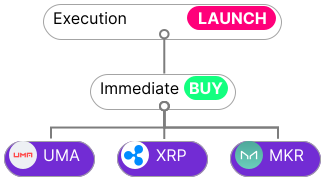
For a Silver accumulation strategy across exchanges, run the same logic on Binance, Kraken, KuCoin and OKX with separate bots per venue. Mirror one rule set with different sizing, then compare fills, fees and performance in one log view. Keep funds on the exchange while the system executes via API keys.



When conditions change, the best move is often doing less. Add a rule that pauses new entries after three consecutive losing trades, or when volatility jumps, such as ATR up 40% week over week. Restart automatically after a cooldown.
Launch BotFAQ
 Sofia G.
 Jason C.
 Lars H.
 Priya K.
 Diego R.
 Yuki T.
Start with one recurring buy and one safety rule. For example, buy every Friday, and pause if price drops 10% in 48 hours. Simplicity makes it easier to evaluate results and avoid accidental overexposure.

Once the base plan works, layer in conditional adds. A common pattern is three levels: add at -3%, -5% and -8%, each at 0.5% of balance. Set a maximum number of adds per week so a fast selloff does not consume your budget.


Treat automation as a measurable process. Review fills, slippage and fees weekly, and note which triggers fired most often. If a rule never triggers, tighten it or remove it to keep the system clean.

Optimization is tempting, but too many tweaks hide what actually helped. Clone the bot, change a single parameter like RSI threshold from 30 to 35, and compare outcomes over a fixed period. This keeps improvements grounded in evidence.

When performance is stable, scale by increasing allocation bands, not by adding complexity. Move from 2% max exposure to 4% only after a full market cycle review. Keep a hard cap so one idea never dominates your portfolio.
Create a bot, connect your exchange, and run your rules with consistent execution. You stay in control with non-custodial access, clear permissions and instant pause controls. Build once, then let the system do the repetitive work.
Get Started