



Turn DeFi Trading into a repeatable process
On this platform you can automate swaps on Uniswap, liquidity adjustments on Aave and rebalancing across Base and Arbitrum using the same rule builder you use for centralized exchanges.
Execute DeFi Trading strategies that bridge on-chain protocols and centralized exchanges using Coinrule to automate swaps liquidity moves and rebalancing across Base, Arbitrum and Ethereum.

375k+
traders running DeFi Trading automation
680k+
DeFi Trading transactions automated
8+
EVM Chains Supported
On this platform you can automate swaps on Uniswap, liquidity adjustments on Aave and rebalancing across Base and Arbitrum using the same rule builder you use for centralized exchanges.
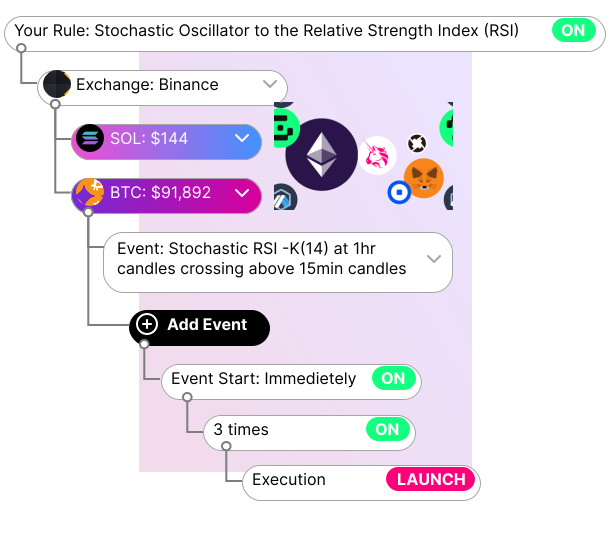
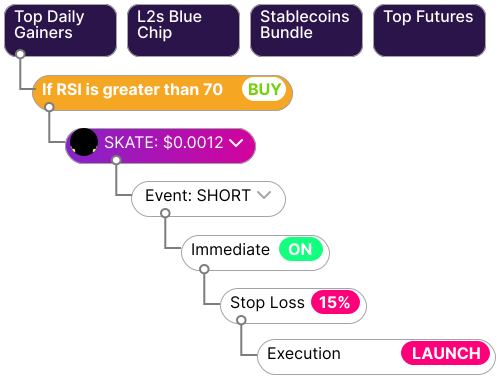
For on-chain execution you work in a visual canvas where actions like swap, approve or stake appear as nodes you connect with conditional triggers.
Gas estimation tools calculate transaction costs before execution so strategies only proceed if profit exceeds fees preventing value leakage.
Risk-Aware DeFi Trading automation
DeFi Trading automation includes on-chain risk filters that check gas costs liquidity depth and slippage estimates before executing swaps or liquidity moves. If Ethereum gas spikes above your threshold or a pool's liquidity falls below safe levels the rule pauses until conditions improve. This prevents costly mistakes during network congestion or low liquidity events on Base or Arbitrum.
Execution layer for DeFi Trading
DeFi Trading execution on Coinrule handles all the low level complexity of on-chain transactions including gas estimation nonce sequencing and transaction confirmation. You define the what and when while the platform manages the how. This separation lets you focus on strategy logic instead of blockchain mechanics across Ethereum Base Arbitrum and other chains.

Rebalance Contrarian
Sells best performer, buys worst, adds 5% take profit and 2% stop. Rotation strategy for DeFi portfolios. Exits at either level. Shifts capital with built-in protection.

Rebalance Trend Following
Sells worst performer, buys best, exits at 5% profit or 2% loss. Opposite rotation with risk management. Bets on strength continuation while protecting downside.

Rebalance With Protection
Sells best, buys worst, adds 5% take profit. Contrarian rotation betting on mean reversion. Locks gains when rotation trade works. Simple two-level exit strategy.

RSI-Based Rebalancing
Buys wallet coins with RSI below 30 on 1-hour charts. Accumulates oversold DeFi positions automatically. Exits when RSI crosses back above 30. Catches panic selling.
Moving Averages-Based Rebalancing
Rebalances by buying coins above 50-day MA, selling those below. Follows trend direction in DeFi holdings. MA acts as bullish/bearish filter. Updates positions daily.
Rebalance Contrarian
Sells best performer, buys worst, adds 5% take profit and 2% stop. Rotation strategy for DeFi portfolios. Exits at either level. Shifts capital with built-in protection.
Rebalance Trend Following
Sells worst performer, buys best, exits at 5% profit or 2% loss. Opposite rotation with risk management. Bets on strength continuation while protecting downside.
Rebalance With Protection
Sells best, buys worst, adds 5% take profit. Contrarian rotation betting on mean reversion. Locks gains when rotation trade works. Simple two-level exit strategy.
RSI-Based Rebalancing
Buys wallet coins with RSI below 30 on 1-hour charts. Accumulates oversold DeFi positions automatically. Exits when RSI crosses back above 30. Catches panic selling.
Moving Averages-Based Rebalancing
Rebalances by buying coins above 50-day MA, selling those below. Follows trend direction in DeFi holdings. MA acts as bullish/bearish filter. Updates positions daily.

Safe Contrarian
Sells any coin rising 5% in one day, buys them back if they drop 3%. Profit-taking with re-entry on pullbacks. Captures DeFi pumps systematically.
Safe Trend Following
Sells coins that drop 5%, buys best performer. Stops losses quickly, redirects to strength. Defensive strategy that reallocates capital away from weakness.
Sell & Reinvest + Take Profit
Sells coins dropping 5%, rebalances to best performer at 5% profit. Two-step rotation with profit target. Exits losing positions and locks gains on replacement trade.
Portfolio Take Profit And Re-buy
Captures global portfolio take-profit by selling any coin that rises 10%. Locks gains across DeFi wallet. Prevents profit erosion during corrections. Portfolio-wide discipline.
Portfolio Stop Loss and Re-buy
Protects wallet with global stop loss, selling coins that drop 10% collectively. Portfolio-level risk management. Overrides individual strategies in drawdown. Capital preservation focus.
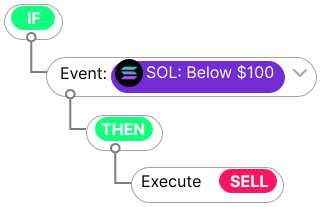
Strategy templates show how to farm yields on Curve, rebalance liquidity on Raydium and hedge via perpetual DEXs, all coordinated from one dashboard.
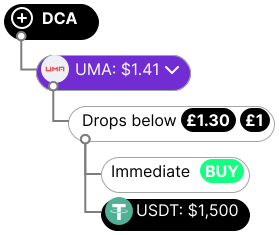
Portfolio views consolidate positions from Base, Arbitrum and Ethereum with real-time valuations so you track net worth without spreadsheet juggling.
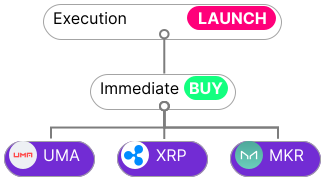
Automated protocols rely on smart contract audits and session keys ensuring bots never hold custody yet still execute your DeFi strategies securely.



DeFi Trading users share that automation has made on-chain portfolio management practical. Instead of manually monitoring gas costs and executing swaps they design rules once and let Coinrule handle the details. They report spending more time on research and less on execution.
StartFAQ
 Dimitrios A.
 Ayesha R.
 Lukas N.
 Zhen L.
 Fatima K.
 Rashid H.
DeFi Trading execution has been refined through thousands of on-chain transactions across Ethereum, Base and Arbitrum. The engine handles gas estimation nonce management transaction confirmation and error recovery automatically. Extensive testing ensures your rules execute reliably even during network congestion.

DeFi Trading automation signs transactions using wallets you control via WalletConnect or similar protocols. Coinrule never holds your private keys or has custody of your on-chain assets. You retain full ownership and control while automation handles execution.


DeFi Trading automation pricing is based on the number of on-chain transactions you execute per month and the number of protocols you connect. Entry plans support a few protocols and limited monthly transactions while higher tiers offer unlimited automation across all supported chains.

Begin DeFi Trading automation with one simple strategy like Uniswap liquidity provision or Aave lending. Run it for a few weeks to understand gas costs execution timing and yield dynamics before adding more protocols or complexity.

Revisit DeFi Trading strategies after protocol upgrades governance changes or major market moves. Check that gas cost assumptions liquidity expectations and yield forecasts still hold. Adjust rules to reflect new on-chain realities.
DeFi Trading can evolve from a single protocol strategy into a comprehensive framework that spans lending liquidity provision governance participation and cross chain arbitrage. Each component shares the same custody model and risk controls.
Launch Bot