



Macro Rules Without The Spreadsheet Grind
Instead of juggling calendars and charts, free macro trading on Coinrule turns your thesis into rules that execute consistently across venues.
Build macro-style rules without coding and automate execution across major crypto venues. Track regimes, rebalance risk, and manage stops from one dashboard.

410k+
users building rules
1M+
strategies executed
20+
Exchanges Supported
Instead of juggling calendars and charts, free macro trading on Coinrule turns your thesis into rules that execute consistently across venues.
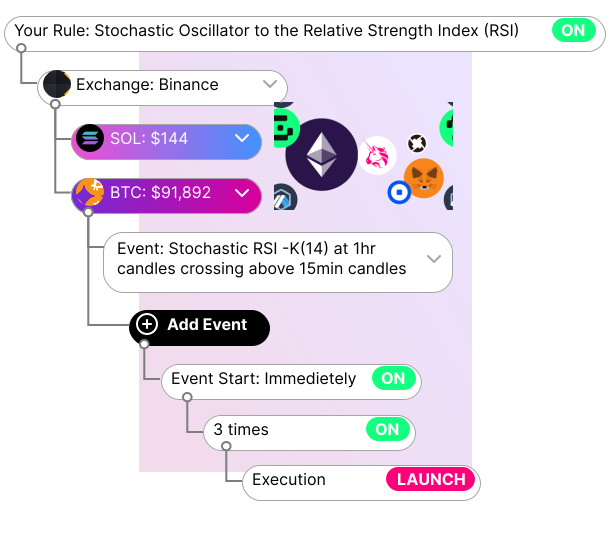
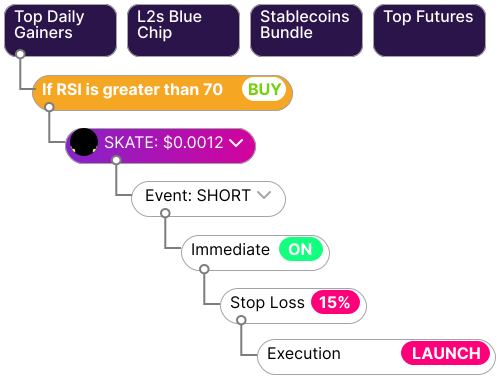
Traders often think in regimes: risk-on, risk-off, and transition. Coinrule lets you express that logic with conditions like trend, volatility and correlation proxies, then route orders to Binance, Kraken, Bybit or Hyperliquid. For example, you can set: if BTC is above MA200 on the daily and ETH/BTC is rising 2% over 7 days, then allocate 60% to BTC and 40% to ETH. If the trend flips, the system can reduce exposure, move to stablecoins, or hedge with perps. You get logs, alerts and a clear audit trail for every decision.
Templates cover trend following, mean reversion and portfolio rotation so you can start with a proven structure. Clone a preset, change the thresholds, and paper-test the logic before going live. Once you like the behavior, schedule checks every 1 hour or 1 day to match your horizon. You can also combine signals, such as MA direction plus a volatility filter, to avoid trading during noisy chop.
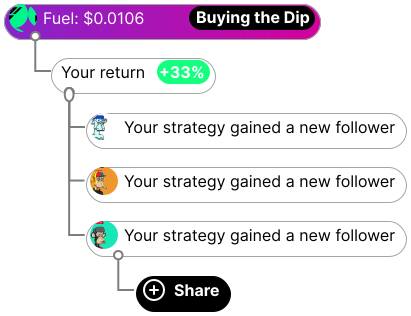
Regime And Risk Controls
Risk controls are first-class rules: max position size, daily loss limits, and cooldown timers after a stop. Set a trailing stop that tightens from 4% to 2% once profit exceeds 8%. Add an alert if drawdown hits 6% in 24 hours so you can review the regime assumptions. These guardrails help you stay systematic when headlines hit.
Multi-Venue Execution
Connect accounts via API keys on CEXs, or use on-chain smart accounts for self-custody execution. The engine can place spot orders, manage perps exposure, and keep allocations aligned without manual re-entry. If you prefer on-chain routes, execution can use smart sessions with limited permissions and route swaps to available liquidity. You stay in control while the automation does the repetitive work.

Risk-On/Risk-Off Macro Switch
Switches exposure based on trend and volatility regime. Enters risk assets when MA200 slopes up and volatility is calm. Moves to a defensive allocation when conditions reverse.

SPY/VIX Risk Sentinel
Uses a volatility proxy to reduce risk during spikes. If volatility rises above a set threshold, it cuts position size and pauses new entries. Re-enables when conditions normalize.

Dollar Index Filtered Trades
Trades only when a dollar strength filter agrees with trend. Enters when price is above MA100 and the filter is favorable. Exits on MA crossback or a time stop.

Volatility Regime Switcher
Detects high vs low volatility and adapts behavior. Runs breakout rules in high vol and mean reversion in low vol. Adds a cooldown after two losses in a row.
Portfolio Rebalance
Rebalances to target weights on a schedule, such as weekly. Sells overweight assets and buys underweight ones. Adds a tolerance band like 3% to avoid over-trading.
Risk-On/Risk-Off Macro Switch
Switches exposure based on trend and volatility regime. Enters risk assets when MA200 slopes up and volatility is calm. Moves to a defensive allocation when conditions reverse.
SPY/VIX Risk Sentinel
Uses a volatility proxy to reduce risk during spikes. If volatility rises above a set threshold, it cuts position size and pauses new entries. Re-enables when conditions normalize.
Dollar Index Filtered Trades
Trades only when a dollar strength filter agrees with trend. Enters when price is above MA100 and the filter is favorable. Exits on MA crossback or a time stop.
Volatility Regime Switcher
Detects high vs low volatility and adapts behavior. Runs breakout rules in high vol and mean reversion in low vol. Adds a cooldown after two losses in a row.
Portfolio Rebalance
Rebalances to target weights on a schedule, such as weekly. Sells overweight assets and buys underweight ones. Adds a tolerance band like 3% to avoid over-trading.
Risk Parity Allocator
Targets balanced risk across assets using volatility estimates. Reduces allocation to the most volatile coin and increases the least volatile. Rechecks on daily candles.
Cross-Asset Correlation Hedge
Adds a hedge when correlations jump and risk clusters. If correlation exceeds a threshold, it reduces exposure and opens a partial hedge. Closes the hedge when correlation falls.
Volatility Targeted Trend
Follows trend while keeping volatility near a target. Increases size when ATR falls and cuts size when ATR rises. Exits on Supertrend flip or a trailing stop.
Beta Hedged Momentum
Buys momentum leaders while hedging market beta. Enters when relative strength is positive over 14 days. Adjusts hedge ratio weekly and exits on momentum fade.

Minimum Variance Rebalance
Shifts weights toward lower variance assets to smooth the equity curve. Rebalances monthly or when drift exceeds 5%. Uses a max allocation cap to prevent concentration.
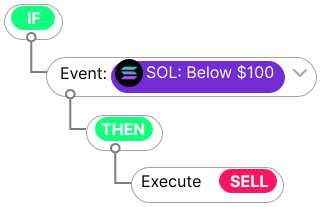
When volatility spikes, you might set: if price drops 5% in 4 hours and funding is between -0.01% and 0.01%, buy 2% of balance and set a 3% stop. Another rule can rebalance weekly: every Monday 10:00 UTC, restore 50/30/20 weights across BTC, ETH and SOL if any drifts by more than 4%. For trend regimes, add: if daily close crosses below MA200, sell 50% and pause new buys for 72 hours. These are simple building blocks that behave like a macro playbook.
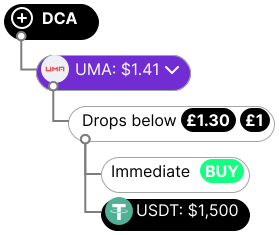
Unlike a single-indicator bot, Coinrule is built for layered logic and portfolio-level decisions. You can combine time schedules, indicator triggers and risk limits in one workflow, then reuse that workflow across multiple exchanges. The interface keeps rules readable so you can review assumptions after a CPI print or a rate decision. And because it is non-custodial, you keep control of funds while automation handles execution.
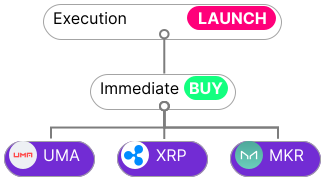
Every bot needs a clear invalidation point. Coinrule helps you define exits first, then entries, so the system does not drift into hope-based holding. Use take-profit ladders, time stops like 14 days, or a trailing exit that activates after 6% profit. Review performance by rule, not by emotion, and iterate with small parameter changes. Over time, your process becomes repeatable and easier to scale.



Link accounts on Binance, Coinbase, OKX, KuCoin and more, then manage them from one place. Run the same logic on spot and perps where supported, or keep separate risk budgets per venue. Alerts and logs stay unified so you can audit decisions quickly. If you trade on-chain, you can execute through smart accounts while keeping self-custody.
Build StrategyFAQ
 Lars H.
 Priya K.
 Michael R.
 Giulia C.
 Kenji M.
 Valentina C.
When you cannot watch screens, systematic checks matter. Schedule rule evaluations at 00:00 UTC daily, or every 4 hours, and let alerts tell you when a condition triggers. You can pause bots during travel, then resume with the same parameters. That consistency is the point.

Macro decisions are often allocation decisions. Coinrule shows positions and performance across connected venues so you can see concentration and drift. Use target weights, caps and exclusions to keep the portfolio coherent. Then let the engine do the rebalancing work.


Add a defensive mode that activates when trend breaks or volatility rises. For instance, reduce exposure by 30% when ATR increases 25% week over week, and open a small hedge until conditions calm. You can also set a time stop so hedges do not linger forever. The goal is controlled behavior, not perfect prediction.

If you prefer decentralized execution, Coinrule can run through smart accounts on Base, Arbitrum and Binance Smart Chain. Session keys can limit permissions so strategies cannot do more than intended. Routing can seek available liquidity to reduce slippage. You keep custody while the system executes.

Clone a live rule before changing it. Adjust one variable at a time, like moving RSI 30 to 35, or changing a stop from 3% to 2.5%. Compare results over a fixed window such as 30 days. This approach keeps improvements measurable.
Create a rule set, connect an exchange, and start with small sizing until behavior matches your expectations. Use alerts, logs and limits to stay accountable. When you are ready, scale the same framework across more assets and venues.
Get Started