



From Experiments To Repeatable Execution
Instead of guessing, you can build a Self learning bot mindset on Coinrule by turning ideas into measurable rules. Set triggers, run them live, and review outcomes in the activity log.
Build a self-learning trading workflow with Coinrule. Create rules, test them, and iterate with logs and alerts across Binance, OKX, Kraken and Bybit.

410k+
users building automations
1M+
strategies created
20+
Exchanges Supported
Instead of guessing, you can build a Self learning bot mindset on Coinrule by turning ideas into measurable rules. Set triggers, run them live, and review outcomes in the activity log.
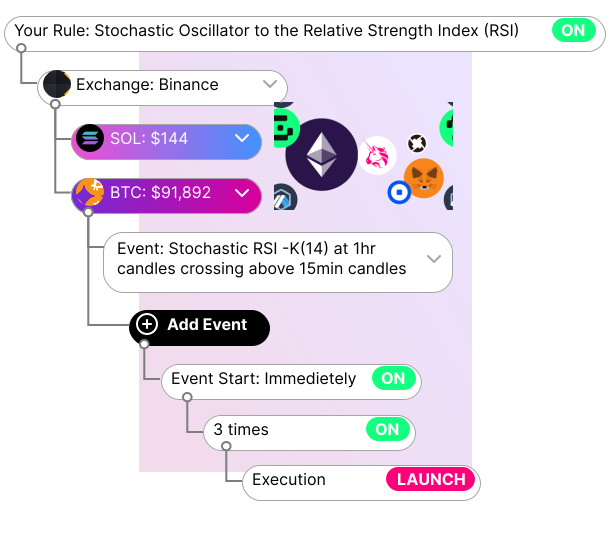
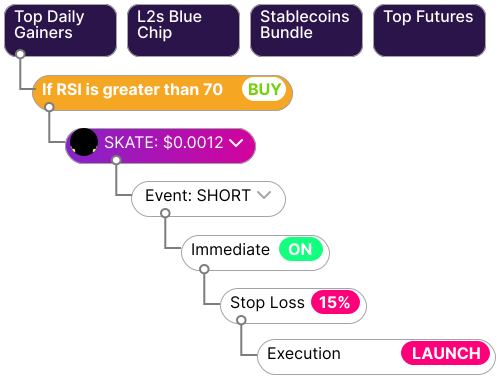
A true adaptive workflow starts with clear hypotheses and clean data. The platform helps you version rules, compare time windows, and see which conditions mattered. Test entries like RSI below 30 on 1-hour candles, then exit at RSI above 55 or a 2.5% take profit. Add a time stop, such as closing after 36 hours if momentum never returns. Learning becomes a routine, not a feeling.
Risk controls make experimentation survivable. Set max position size at 3% per trade, a daily loss cap at 2%, and a 4-hour cooldown after any stop loss. When volatility spikes, require confirmation like price above MA200 before new entries. These constraints reduce overreaction to noise while you refine signals.
Feedback Loops And Versions
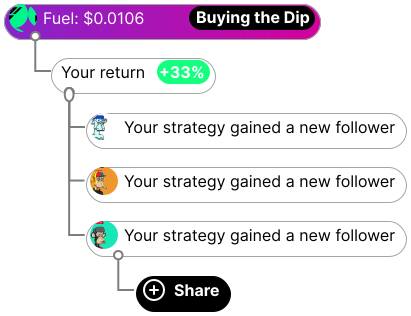
Templates give you a baseline, then you tune one variable at a time. Change only RSI from 32 to 28, or tighten a trailing stop from 4% to 2%, and compare results over the same 30-day range. Coinrule logs every trigger so you can see why a trade happened, not just PnL. That visibility speeds up iteration.
Multi-Exchange Execution
Connect venues like Bybit, Bitget, Coinbase and Hyperliquid to run the same logic where liquidity fits your plan. You keep custody on the exchange while Coinrule executes via API keys and applies the same risk limits everywhere.

Buy the Dips
Buys when price drops 5% from a 24-hour high and RSI is below 40. Adds one more buy if price drops another 3%. Exits on a 4% rebound or a 2.5% trailing stop.

Grid Trading
Places a grid inside a defined range, like +/-6% around current price. Buys at lower bands and sells at upper bands. Pauses new orders if price breaks the range by 2%.
Optimised RSI and MA Strategy
Enters when RSI crosses above 30 while price is above MA100 on 4-hour candles. Takes profit at 3% and trails by 1.8% after profit exceeds 2%. Stops out at -2.2%.
Volatility Breakout
Buys when price closes above the prior 20-candle high and ATR expands by 15%. Uses a 2.5% initial stop loss. Exits on a close back below the breakout level or a 3% take profit.

Stop Loss and Trailing Take Profit
Opens on a simple trend filter, then manages risk automatically. Sets a fixed stop at 2% and activates a trailing take profit of 1.5% after price moves 2% in your favor.
Buy the Dips
Buys when price drops 5% from a 24-hour high and RSI is below 40. Adds one more buy if price drops another 3%. Exits on a 4% rebound or a 2.5% trailing stop.
Grid Trading
Places a grid inside a defined range, like +/-6% around current price. Buys at lower bands and sells at upper bands. Pauses new orders if price breaks the range by 2%.
Optimised RSI and MA Strategy
Enters when RSI crosses above 30 while price is above MA100 on 4-hour candles. Takes profit at 3% and trails by 1.8% after profit exceeds 2%. Stops out at -2.2%.
Volatility Breakout
Buys when price closes above the prior 20-candle high and ATR expands by 15%. Uses a 2.5% initial stop loss. Exits on a close back below the breakout level or a 3% take profit.
Stop Loss and Trailing Take Profit
Opens on a simple trend filter, then manages risk automatically. Sets a fixed stop at 2% and activates a trailing take profit of 1.5% after price moves 2% in your favor.
MA Crossover with Volume Filter
Buys when MA20 crosses above MA50 and volume is 20% above its 14-period average. Exits when MA20 crosses back below MA50. Adds a 2% stop loss to limit downside.

Bollinger Band Mean Reversion
Buys when price closes below the lower band and RSI is under 35 on 1-hour candles. Sells at the middle band or on a 2% profit target. Uses a time stop after 24 hours.
Supertrend Momentum
Enters when Supertrend flips bullish on 4-hour candles and price makes a higher high. Exits when Supertrend flips bearish. Optional trailing stop tightens from 3% to 1.5% after 8% profit.
DCA Accumulator
Splits a monthly budget into scheduled buys, like $500 into four $125 weekly entries. Skips a buy if price is 10% above the 30-day average. Adds a protective stop after the position is built.
RSI Divergence Hunter
Looks for bullish divergence: price makes a lower low while RSI makes a higher low on 2-hour candles. Enters on confirmation with a close above the prior candle high. Exits at 3% profit or -2% stop.
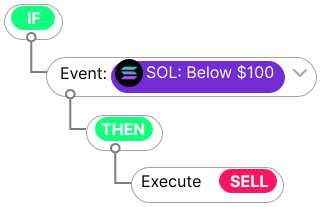
Unlike black-box promises, Coinrule focuses on learnable rules with clear triggers, exits and review. Start with one market and timeframe, then widen scope only after you can explain results. A Self learning bot approach works best when you track changes like a lab notebook. Use notes, tags and clones so you never lose what worked. For a deeper overview of systematic execution, see /automated-trading.
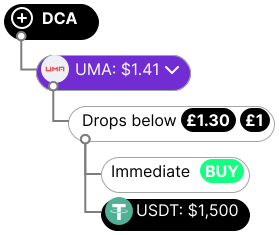
Traders often change too many things at once. Run A/B tests by keeping entries identical and adjusting only exits, or the reverse. Compare a fixed 3% take profit versus a 1.8% trailing take profit over the same 200 trades. Keep the winner, then move to the next variable to improve without overfitting.
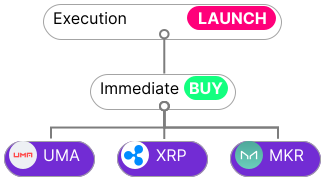
When volatility rises, signals can fire more often and amplify mistakes. Add a regime filter like ADX above 20 for trend systems, or require price inside Bollinger Bands for mean reversion. Pair every entry with a stop loss, position sizing and a max open trades limit, such as 3 concurrent positions. These controls keep the learning loop stable during fast markets.



Portfolio views help you avoid accidental concentration. Set allocation caps per coin, rebalance on a schedule, and keep stablecoin reserves for planned entries. Stagger strategies so they do not all trigger on the same candle. The result is smoother exposure and fewer surprises.
Launch BotFAQ
 Lars H.
 Priya K.
 James W.
 Mei L.
 Diego R.
 Sarah K.
Start with a template close to your idea and define one measurable goal. Set a review cadence, like every Sunday, and record what you changed. Scale only after you see stability across at least two market regimes.

Set real-time notifications for key events like a stop loss hit, drawdown above 3%, or more than 5 triggers in an hour. Alerts help you catch broken assumptions early and reduce screen time.


If a rule only works on one coin, one month and one timeframe, it is likely curve-fit. Use broad filters, limit indicators, and keep thresholds interpretable. A small edge repeated consistently beats a complex rule you cannot explain.

Once a strategy is stable, duplicate it to similar pairs and adjust only volatility settings like ATR-based stops. Keep sizing consistent, then expand gradually. Multi-exchange execution helps you compare fills and fees objectively.

Coinrule does not take custody of your assets. You trade from your own exchange accounts and can revoke API access at any time. For on-chain automation, smart accounts and session keys can limit permissions while keeping control.
If you can describe your entry, exit and risk rules, you can automate them and improve them. Start small, measure honestly, and let process beat impulse. Coinrule gives you the tools to iterate with clarity.
Get Started