



Automate spread checks with guardrails
A Crypto Arbitrage Bot is only useful if it accounts for real execution: fees, slippage, and delays. Coinrule helps you codify entry thresholds, sizing, and limits so actions stay controlled and reviewable.
Build a Crypto Arbitrage Bot that stays realistic: monitor spreads, account for fees and slippage, and execute with strict limits across Binance, Kraken and Bybit.

410k+
users building automation
1.4M+
rule checks run
8+
exchanges supported
A Crypto Arbitrage Bot is only useful if it accounts for real execution: fees, slippage, and delays. Coinrule helps you codify entry thresholds, sizing, and limits so actions stay controlled and reviewable.
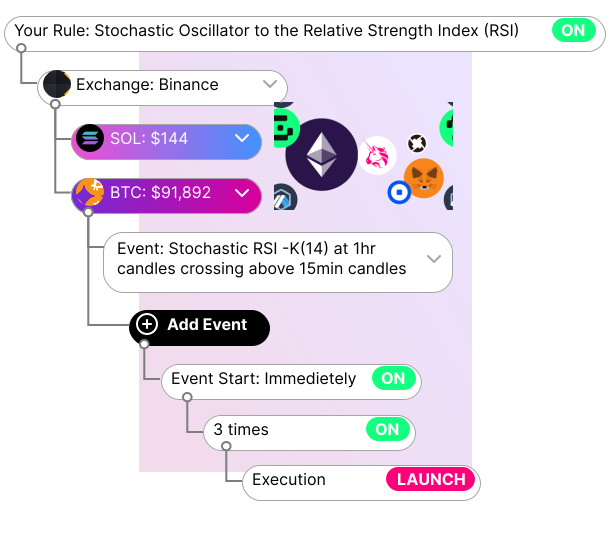
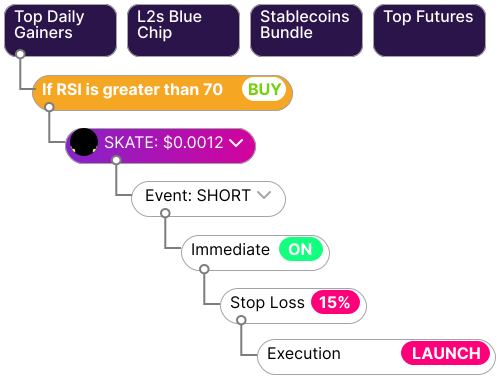
Set a minimum spread threshold that includes trading fees and an estimated slippage buffer. Add cooldowns and max trade counts so the bot does not chase noise during fast markets.
Arbitrage often requires holding balances on multiple venues. Use position caps and exposure limits to keep inventory risk bounded, and use logs to review fills and partial fills.
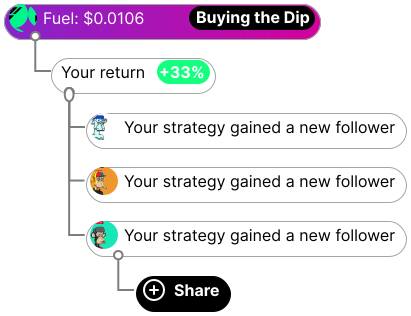
Execution discipline
Attach stop logic, maximum slippage, and timeouts so orders do not linger. If spreads compress, the system can pause or reduce size to keep risk proportional.
Transparent automation
Start in demo to validate behavior, then go live with the same rules once assumptions are reasonable. For related pages, see /crypto-arbitrage-bot and /arbitrage-bot.

Market Leader Breakout
Trigger entries only when a minimum spread threshold is met and liquidity is stable. Add a cooldown window. A control-first approach for arbitrage-style monitoring.

Low Volatility Buy And Sell
Reduce activity when volatility rises and spreads become noisy. Resume when conditions normalize. Helps keep a Crypto Arbitrage Bot from chasing unstable signals.
Buy + Stop Loss And Take Profit
Attach protective stops and take-profit rules so inventory risk stays bounded. Cancel if conditions change. Keeps execution disciplined when spreads compress.
Moving Average Scalper
Use short-term signals to capture brief dislocations, then exit quickly. Enforce tight limits and cooldowns. Built for fast checks, not constant trading.
Bollinger Band Below Price
Enter only when price deviates beyond a band and exit as it mean-reverts. Include fee and slippage buffers in your thresholds. A structured way to model dislocations.
Market Leader Breakout
Trigger entries only when a minimum spread threshold is met and liquidity is stable. Add a cooldown window. A control-first approach for arbitrage-style monitoring.
Low Volatility Buy And Sell
Reduce activity when volatility rises and spreads become noisy. Resume when conditions normalize. Helps keep a Crypto Arbitrage Bot from chasing unstable signals.
Buy + Stop Loss And Take Profit
Attach protective stops and take-profit rules so inventory risk stays bounded. Cancel if conditions change. Keeps execution disciplined when spreads compress.
Moving Average Scalper
Use short-term signals to capture brief dislocations, then exit quickly. Enforce tight limits and cooldowns. Built for fast checks, not constant trading.
Bollinger Band Below Price
Enter only when price deviates beyond a band and exit as it mean-reverts. Include fee and slippage buffers in your thresholds. A structured way to model dislocations.

Bollinger Band Below Price with RSI
Combine band signals with RSI confirmation to reduce false positives. Add max slippage limits. Helps keep arbitrage logic from triggering on thin liquidity.

Maximized RSI Strategy
Use oversold/overbought triggers as a proxy for dislocation, then enforce strict sizing and timeouts. Designed to keep entries selective and reviewable.
EMA Cross Under Strategy
Reduce exposure when momentum turns against you and re-enter only when conditions recover. A defensive rule for inventory management across venues.
Ichimoku Cloud with MACD
Enter when Ichimoku and MACD align, then exit on breakdown. Use this as a filter so arbitrage-style actions are not taken against strong trends.

Ichimoku Cloud with RSI
Enter when price is above the cloud and RSI supports momentum, and avoid trades when trend context is weak. Helps filter out low-quality dislocations.
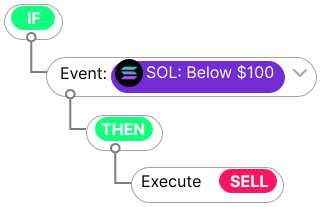
Arbitrage is sensitive to latency, fees, and slippage. Start with conservative thresholds, validate fills, and size small until your assumptions match real execution.
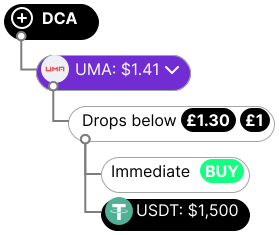
Include maker/taker fees and an estimated slippage buffer in your minimum spread. If you do not model costs, your bot may trade actively without meaningful edge.
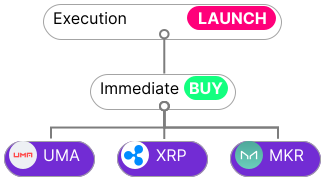
Set timeouts, max trades per hour, and per-asset exposure caps. These controls reduce the chance of chasing fleeting spreads during fast moves.



Logs make arbitrage workflows safer. Review where fills slipped, where spreads vanished, and where inventory drifted, then update one variable at a time.
Build StrategyFAQ
 Pino F.
 Mark M.
 Alex C.
 Ginar L.
 Beatrice C.
 Rebecca S.
Start with one pair, one threshold, and strict limits. Complexity can hide risk when spreads move quickly.

Add cooldowns and max trades per hour. Arbitrage setups can churn fees if you do not enforce trade frequency controls.


Inventory risk is real when balances sit on multiple exchanges. Cap exposure per asset and review drift regularly.

During major news, spreads and slippage can widen unpredictably. Pause the bot, then resume once conditions normalize.

Review logs weekly, change one variable, and measure the impact. Routine improvements beat reactive edits after one trade.
Prove behavior on one venue set and one pair, then add a second after review. Gradual scaling keeps the bot manageable.
View Plans