



Treat bots as a portfolio
Cryptocurrency Trading Bots work best when you manage them as a portfolio: different strategies, overlapping pairs, and allocation limits. Keep overlap visible and adjust sizing instead of guessing.
Run Cryptocurrency Trading Bots as a portfolio: templates for dips, grids and trends, plus allocation limits and logs across Binance, Kraken and Bybit.

395k+
users building automation
1.6M+
rule checks completed
1,100+
trading pairs
Cryptocurrency Trading Bots work best when you manage them as a portfolio: different strategies, overlapping pairs, and allocation limits. Keep overlap visible and adjust sizing instead of guessing.
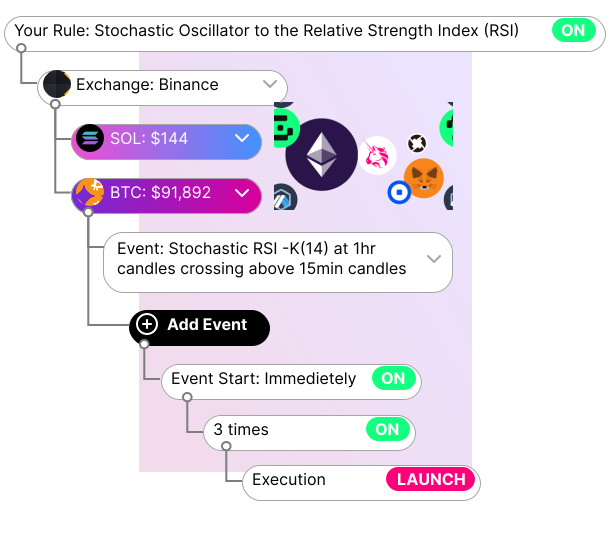
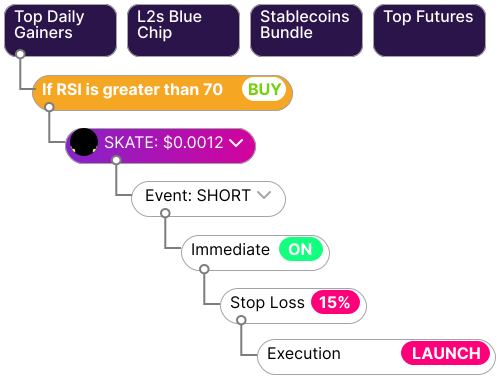
Use pre-built templates for dips, grids and trends, then customize thresholds. Templates give you a baseline to compare your own ideas against.
Risk caps, cooldowns, position limits, and stop rules are part of the bot portfolio, not optional extras. Guardrails prevent overtrading when conditions change.
Explainable signals
Use moving averages, RSI, MACD and volatility filters with a clear reason for each. Fewer signals make debugging easier and reduce fragile strategies.
Logs for iteration
Logs show what triggered and what executed, so reviews are honest. For related pages, see /crypto-bots and /trading-bots.

Market Leader Breakout
Enter when price breaks above a recent high with confirmation. Exit on trailing stop or risk cap. A clean algorithm for momentum regimes.
EMA Crossings with RSI
Enter on an EMA cross only when RSI confirms strength. Exit on crossback or trailing logic. Filters weak signals and reduces churn during chop.

Bollinger Band Below Price with RSI
Combine band signals with RSI confirmation to reduce false positives. Add a stop and cooldown. Useful for mean-reversion algorithms.

MFI Oversold and Overbought
Buy when MFI signals capitulation and sell when MFI becomes overbought. Add a time stop. Keeps signals explainable for systematic testing.

Moving Averages-Based Rebalancing
Rebalance a portfolio to target weights on a schedule with drift thresholds. A disciplined algorithm for long-horizon execution.
Market Leader Breakout
Enter when price breaks above a recent high with confirmation. Exit on trailing stop or risk cap. A clean algorithm for momentum regimes.
EMA Crossings with RSI
Enter on an EMA cross only when RSI confirms strength. Exit on crossback or trailing logic. Filters weak signals and reduces churn during chop.
Bollinger Band Below Price with RSI
Combine band signals with RSI confirmation to reduce false positives. Add a stop and cooldown. Useful for mean-reversion algorithms.
MFI Oversold and Overbought
Buy when MFI signals capitulation and sell when MFI becomes overbought. Add a time stop. Keeps signals explainable for systematic testing.
Moving Averages-Based Rebalancing
Rebalance a portfolio to target weights on a schedule with drift thresholds. A disciplined algorithm for long-horizon execution.

Grid Trading
Run a grid on a liquid pair inside a defined range. Pause if conditions break. A structured algorithm for sideways markets.
Buy the Dips
Accumulate after controlled pullbacks and take profit at preset levels. Use cooldowns. A baseline algorithm for range-to-trend transitions.
Dip Recovery TWAP & RSI
Scale in using TWAP after an oversold signal, then exit as RSI normalizes. Add a volatility filter. Smooths entries when signals are noisy.
Bollinger Band Below Price
Enter only when price deviates beyond a band and exit as it mean-reverts. Add a stop and cooldown. A measurable range algorithm.
Ichimoku Cloud with MACD
Enter when Ichimoku and MACD align, then exit on breakdown. Use strict sizing. A structured template for trend entries.
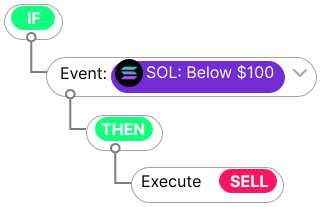
When results drift, use logs to isolate what changed. Debug one variable at a time so improvements are measurable.
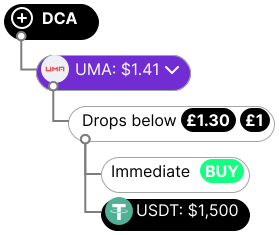
Too many indicators can conflict. Use a small set with clear intent so each bot stays explainable.
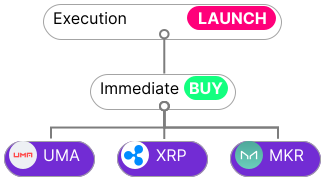
Save versions before edits, then compare outcomes. Clean versioning prevents messy experiments and false conclusions.



When volatility spikes, reduce sizing and widen filters. A good bot portfolio adapts by tightening risk, not trading more.
Create StrategyFAQ
 Emeka N.
 Ingrid H.
 Rafael T.
 Sakura Y.
 Omar Z.
 Bianca F.
Decide how often rules should check: faster for active setups, slower for calmer investing. Keep cadence stable so results are comparable.

Keep conditions simple: one filter, one trigger, one exit plan. Too many signals can create fragility and constant tweaking.


If you cannot explain your maximum risk, add limits until you can. Constraints make automation easier to trust.

Pause automation during major news, then resume when volatility settles. You keep control without rewriting your strategy.

Review logs weekly and change one variable. Routine improvements beat reactive edits after one trade.
Start with one bot, then expand after review. Gradual scaling keeps execution understandable and manageable.
Start Today